The Build: What It Actually Takes to Renovate a 1911 Kitchen

The Build: What It Actually Takes to Renovate a 1911 Kitchen

The Build: What It Actually Takes to Renovate a 1911 Kitchen


There is a version of a kitchen renovation that exists in renderings — clean lines, finishes selected, everything in its place. And then there is the version that exists before that one, where the walls are open and the floors are covered in a century’s worth of decisions that have to be undone before anything new can begin.

This is that post.

The dust

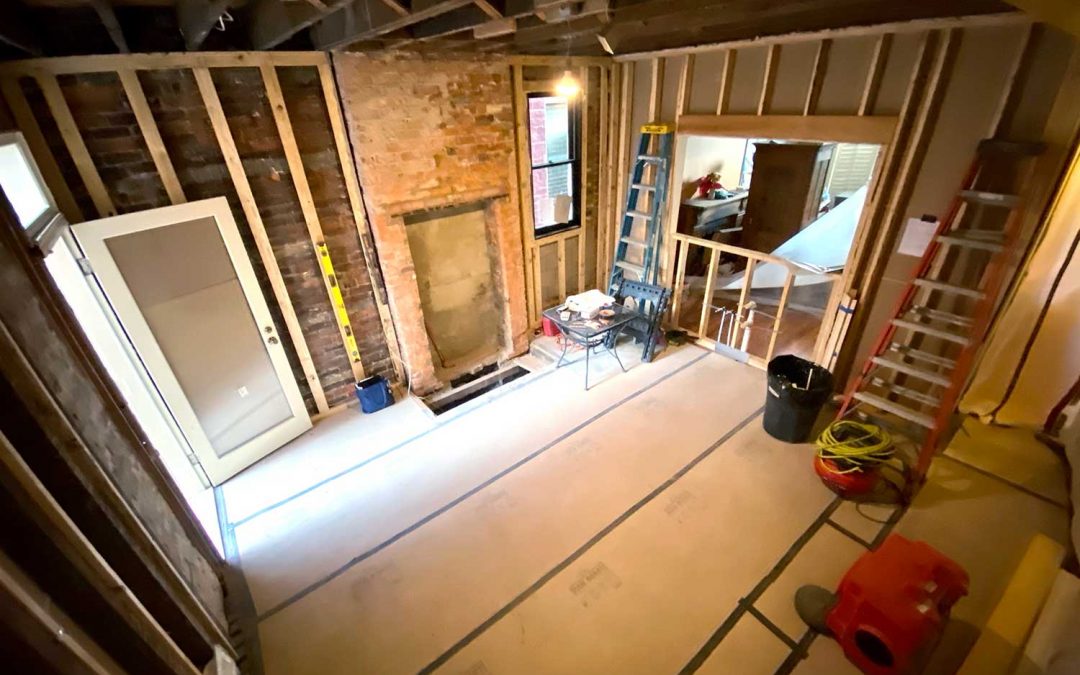
The wood paneling came off first, then the plaster and lath walls. Plaster dust is some of the finest particulate you will ever encounter in a renovation — it travels. It doesn’t stay in the room you’re working in. It finds its way into every other room, settles on every surface, and coats everything in a layer that feels almost silky until you realize it’s been three days and it’s still there.

The drywallers came in after demo. Drywall sanding dust is similarly fine, though it doesn’t travel quite as aggressively. And then came the floors.

Floor sanding dust is in a category of its own. It lands on exposed skin and pulls the moisture out of it. Face masks needed to be changed nearly every hour. A shop vac handles what it can, but the dust wins most of the time. Anyone who tells you a renovation is clean has never opened up a 110-year-old house.

What was inside the walls

Once the walls were open, the first thing that became visible was knob and tube wiring — the original electrical system, still in place throughout the house. It had been spliced into both aluminum wire and copper romex, which is among the more hazardous combinations you can find in an old home. The decision was straightforward: full rewire, the entire house, not just the kitchen.

The electricians were in the house for three weeks on the rough-in alone. Some of the kitchen wiring had to wait until after the cabinets were installed.

The HVAC was a separate project entirely. This house got a full mini-split system — individual head units in each room, fed by copper line sets running from outdoor condensing units. Installing line sets through a 1911 house means feeding two insulated copper pipes, an electrical wire, and a condensate drain line through walls built with old-growth lumber used as studs — dense, massive, and not interested in cooperating. Eight line sets total, four running through the kitchen walls.

My dad came down to help run them — four of us working simultaneously across three floors, my husband in

 the crawlspace feeding lines up through the floor, our neighbour on the second floor passing them up, and my dad pulling them into the attic while I worked the main floor. We spent most of the time shouting to each other through walls thick enough to swallow the sound.

Here is a short video of me feeding a line set through a wall. It was three seconds long, but I slowed it down to show 10 seconds.


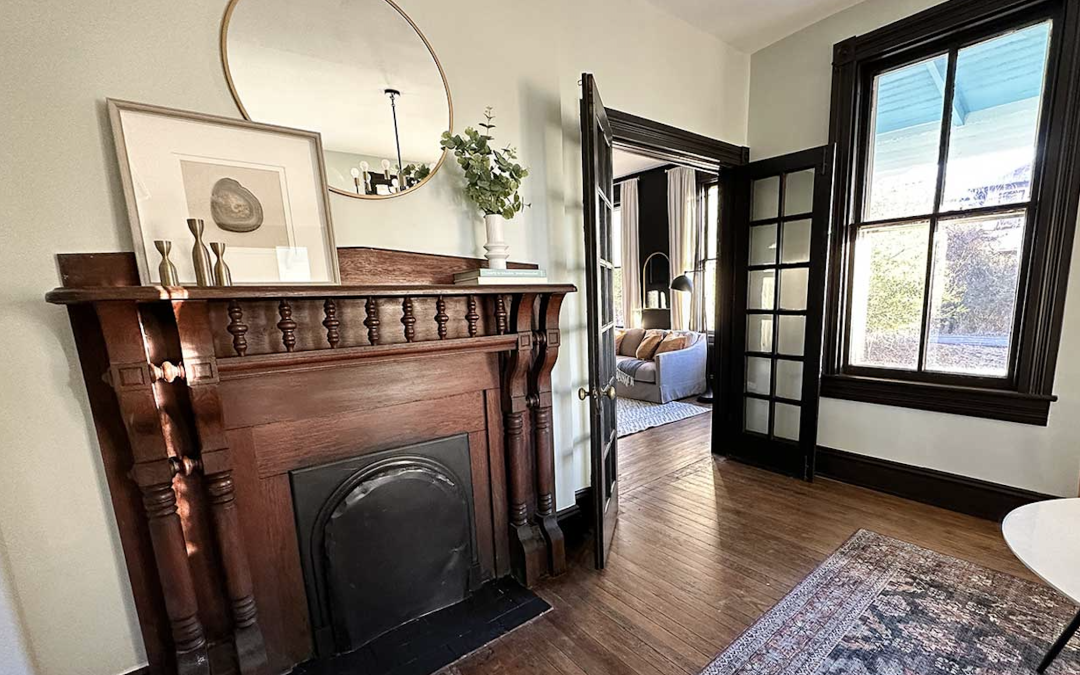
There was also a happy surprise. When the walls opened up above the fireplace mantel, the original brick was there — intact, just waiting. It stayed exposed. It’s still there.

The floors

The floors are original heart pine — old-growth, dense, narrow-grained, the kind of wood that doesn’t exist in new construction anymore. They were also cupped, which is what happens to old wood floors over time as moisture works through them unevenly, and they had adhesive from a previous surface bonded directly to them.

Getting them back meant sanding by hand — my husband, my brother, a neighbour, and me, working through the glue room by room. Heart pine at this age responds differently than newer wood — it has to be read as you go. The result was worth every hour of it. Refinished, the floors became the anchor of the room.

The trim

When the original trim came off during demo, most of it came apart in pieces. Some was salvageable. Most wasn’t. The millwork in this house — the entryway, the living room, the study — is part of what makes it what it is, and matching it convincingly matters.

A specialty wood shop had a knife profile already cut that was close enough to the original that it’s genuinely difficult to tell them apart. The new trim went in alongside what could be saved, and the room reads as continuous. That’s the goal — not perfect preservation, but seamless integration.


The finishes

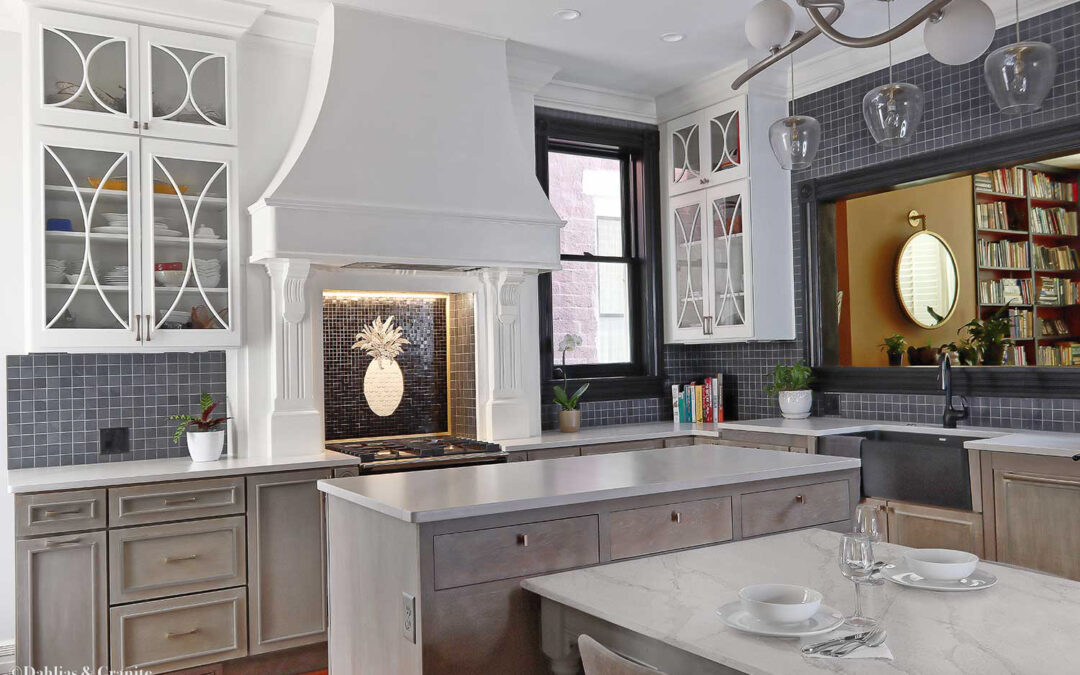
The cabinet color went through its own process. White cabinets are beautiful in principle — and impractical in a kitchen where two people cook seriously and messes are part of the work. The cabinet makers produced samples based on a reference image, landing on a stain and glaze that reads somewhere between driftwood and warm grey. Neither painted nor natural. A tone that felt like it had always been in the home.

The sink configuration was a 60/40 over a standard 50/50 — larger and deeper on the main side, sized to lay a full plate flat. For a kitchen where preserving is part of the work, that matters.

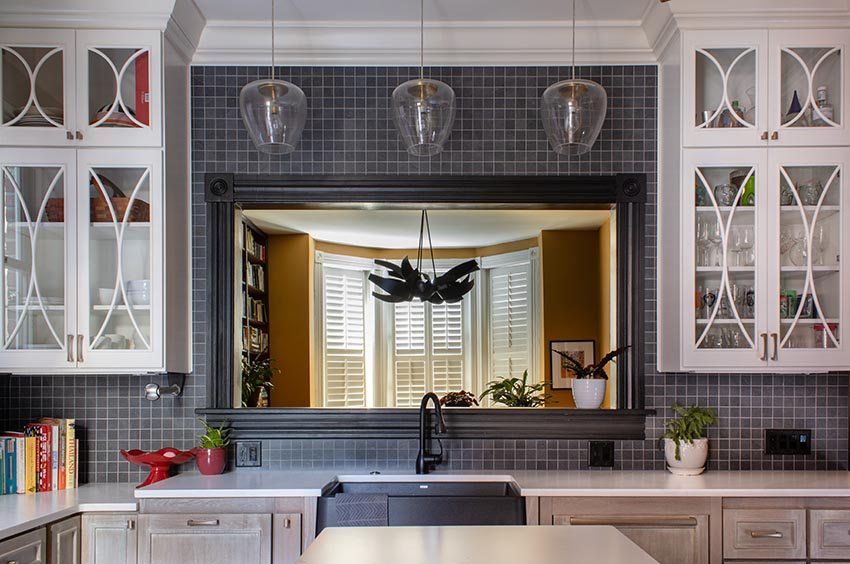
The granite slab was selected in person at the supplier, which is the only way to choose stone. A slab that reads as grey and white in a sample board has movement and depth in full scale — it shifts with the light. In a kitchen with three bay windows, that’s not a small thing. The right slab was identifiable the moment I saw it. I called the supplier from the cabinet maker’s studio and asked her to hold it.

I made the floating shelves from raw ash slab — cut, sanded through multiple grits, sealed, and installed on hidden brackets myself. The kind of detail that reads as simple once it’s done, and is anything but.


Studio Olio specializes in historic home renovation in Denver and remotely. If you’re planning a kitchen renovation and want to understand what’s possible — start with a complimentary discovery call.

→ Next: The Finished Kitchen: A 1911 Folk Victorian

← Previous: The Layout: Five Openings, a Fireplace, and How a Room Tells You What It Needs


Frequently Asked Questions

What should you do if you find knob and tube wiring during a historic home renovation?

It depends on the condition. Knob and tube that is unspliced and has intact insulation can, in some circumstances, be left in place — it’s the modifications that make it dangerous. In this house, the wiring had been spliced into both aluminum wire and copper romex, which is among the more hazardous combinations you can find in an old home. That made the decision straightforward: full house rewire, not just the kitchen. If the walls are already open and the wiring has been compromised, there’s no good argument for leaving it.

Can original hardwood floors be saved if they have glue or adhesive on them?

Usually yes, though it takes more work than a standard refinish. Old-growth hardwoods like heart pine are dense enough to sand through most adhesives, but cupping and uneven surfaces require reading the floor as you go rather than running a drum sander straight through. The result is nearly always worth the effort.

How do you match original trim in a historic home renovation?

Find a specialty millwork shop that can match the profile. Most historic trim was cut with specific knife profiles that a good shop can replicate from a sample of the original — or from a measurement if the original is too damaged. The goal is seamless integration, not a perfect copy of something that no longer exists.

How do you manage dust during a historic home renovation?

You manage it, but you don’t eliminate it. Plaster, drywall, and floor sanding each produce different dust with different behavior — plaster travels the farthest, floor sanding is the most physically demanding to work through. An air scrubber is worth having on site — unlike a regular fan, it pulls particulates through a HEPA filter rather than just redistributing them. Containment helps. A shop vac helps. Changing your face mask regularly helps. Accepting that everything will be coated in something fine and gritty for the duration of the project helps most of all.


The Layout: Five Openings, a Fireplace, and What Victorian Homes Were Actually Saying

The Layout: Five Openings, a Fireplace, and What Victorian Homes Were Actually Saying

Before anything gets built, there’s a period where the room exists only on paper — and the job is to find the layout that stops arguing with itself.

For this kitchen, that took five iterations before I got to two concepts worth presenting. A room with three bay windows, two single doors, a set of French doors, an original built-in, and a fireplace requires that kind of rigor. Every opening is a constraint, and constraints in a room like this compound quickly.

What the constraints were

The room is 14 by 15 feet at its widest point — generous for a Victorian kitchen, which is part of why it was the right room. But the five openings ate into that generosity fast. Every door, every window, every built-in created a zone you couldn’t put cabinetry in front of. The fireplace took a full wall section. The French doors to the living room needed clearance on both sides.

What was left, once you accounted for all of it, was two functional walls. The constraints didn’t feel like limitations once I stopped working against them — they clarified the decisions, because they eliminated most of the options.


What got decided and why

The sink wall went between the two single doors — the only run long enough to hold it. Open shelving above rather than upper cabinets, because upper cabinets in a room with this much light and this many original details would have competed with what was already there. I built the shelves from ash slab — cut, sanded, sealed, and installed on hidden brackets.

The island went in the center of the room with the cooktop built in. The orientation was deliberate: sitting at either end of the island, the bay windows are directly behind you — the light, the greenery, the shelf of plants. The island had to be shortened from the original plan — the flow from the living room to the refrigerator required it, which is something you confirm by taping the layout on the actual floor and walking every path before anything gets built.

No upper cabinets anywhere in the room. The bay windows needed a plant shelf, not cabinetry. The built-in painted black, with the botanical wallpaper — black ground, gold branches — running the full wall on either side. That wall didn’t need anything else.


The built-in

The original built-in stayed exactly where it was. The passthrough behind its doors still connects to the butler’s pantry, exactly as it was designed to do a hundred years ago. Finishes like the wallpaper are confirmed on site, once the bones are in place and the room’s character becomes clear — not on a mood board. In a historic home, the room usually tells you what it needs. This one was no different.


What a layout actually is

A floor plan is the result of knowing — knowing how people move through a kitchen, how light shifts through the day, how a room with this many constraints wants to be organized. The iterations aren’t guesswork. They’re a process of elimination that only works if you understand what you’re eliminating and why. By the time a layout gets built, the decisions have already been made. The construction just makes them permanent.

In this kitchen, the layout that worked wasn’t the most obvious one — it was the one that listened to what the room already was. Five openings, a fireplace, a built-in with a century of logic behind it. The room was already telling you what it needed. The job was to stop proposing alternatives and start paying attention.


Studio Olio specializes in historic home renovation in Denver and remotely. If you’re planning a kitchen renovation and want to understand what’s possible — start with a complimentary discovery call.

→ Next: The Build — What It Actually Took

← Previous: Moving the Kitchen: A 1911 Folk Victorian


Frequently Asked Questions

Should I keep the original built-ins in a historic home?

Almost always yes. Original millwork is the hardest thing to replicate convincingly. Removing it saves almost nothing and costs the home something it can’t get back.

What do you do when a historic room has too many openings for a functional layout?

You work with what the room gives you. In this kitchen, five openings left two usable walls — that determined everything: where the sink went, where the island went, why there are no upper cabinets. Constraints in old homes are usually solvable once you stop fighting them.

Why avoid upper cabinets in a historic kitchen renovation?

Upper cabinets work well in kitchens that need visual weight or additional storage. In a room with original millwork, significant window area, or strong architectural details, they often compete with what’s already there. Open shelving keeps the room breathing and lets the bones show.

Moving the Kitchen: A 1911 Folk Victorian

Moving the Kitchen: A 1911 Folk Victorian

Every contractor who walked through said the same thing. They were all wrong.

The first question every contractor asked when they walked through the home was the same: “How about we just put the kitchen where the old kitchen was?”

Every time, my answer was no.

The original kitchen was the smallest room in the home. One window. The main back entry — where you came in from the car, from the yard, from the world — opened directly into it. It was dark, it was cramped, and it sat at the back of a Folk Victorian built in 1911 that deserved better.

I knew where the kitchen needed to go the moment I walked into the room in the middle of the home.

The room that wanted to be a kitchen

Three large bay windows. Greenery outside. Light coming in that changes through the day and makes a room feel alive.

The room had almost certainly been the dining room at some point — there was a built-in passthrough directly from the walk-in pantry, which told you everything about how the home had originally been organized. Someone had understood this home once. The passthrough was staying.

There was also a fireplace. Original, like all of them in the home. Not working, but present — the kind of detail you don’t erase just because it’s inconvenient. It stayed.

And then there were the openings: three large bay windows, two single doors, and a set of French doors leading to the living room. Five openings in one room, plus a fireplace, plus a built-in. Every contractor who said no was looking at that and seeing a problem. I was looking at it and seeing a kitchen.


What made the original kitchen wrong

The size was wrong. One window in a home full of light is a waste. But neither of those was the real problem.

Victorian kitchens were never meant to be seen. They were back-of-house by design — separated from guests, separated from family rooms, tucked away from everything that constituted the presentation of the home. The kitchen was a workspace. It produced heat, smell, noise, and mess, and the entire floor plan was organized to keep all of that invisible.

The butler’s pantry was the pressure valve. It sat between the kitchen and the dining room and did several things at once: it staged meals before they were presented, stored china and silver and linens, and kept the chaos of the kitchen completely hidden from anyone sitting at the dining table. Food moved through it quietly, in an organized way, without the dining experience ever touching the work that produced it.

The back stairs did the same thing for movement. Whoever was running the household could move between floors without using the main staircase. Supplies went up, laundry came down, and the front of the home stayed calm. Two parallel systems: one for living, one for running the home. The layout wasn’t decorative. It was functional logic.

By the time I bought this home, the staff were long gone — but the bones remained. The butler’s pantry was still there, tucked under the rear staircase, with shelves on each side and a large window. The passthrough was still there, connecting it directly to the room that would become the kitchen. The rear staircase was still there, but it no longer worked for modern living.

Moving the kitchen corrected that. The old kitchen became what a back-entry room with a parking-side door actually wants to be: laundry, mud room, tool storage. The home didn’t lose a room. It gained two.


The decision

Moving a kitchen in a historic home means new plumbing, new electrical, new ventilation — all of it relocated, all of it permitted. Every contractor saw the cost and the complexity and suggested the path of least resistance.

But the path of least resistance would have left the smallest, darkest room in the home doing the heaviest daily work, while the room with three bay windows and an original fireplace sat there being something lesser. That’s not a renovation. That’s just moving furniture around inside a problem.


What it became

The island and the bay windows became the anchor of the room — the kind of place where you sit down with coffee and don’t leave. I could watch the birds out those windows for hours. The flow worked. The storage worked, especially once the butler’s pantry found its home under the second staircase — but that’s the next post.

This renovation made something clear to me that I haven’t stopped believing since: historic homes already know how they want to be organized. The logic is in the bones. The job isn’t to impose a new plan — it’s to find the one that was always there.

That’s why I do this work.

Studio Olio specializes in historic home renovation in Denver and remotely. If you’re planning a kitchen renovation and want to understand what’s possible — start with a complimentary discovery call.

→ Next: The Layout — Five Openings, a Fireplace, and Why Victorian Homes Were Built the Way They Were


Frequently Asked Questions

Can you move a kitchen in a historic home?

Yes — though it means relocating plumbing, electrical, and ventilation, all permitted. The question isn’t whether it’s possible, it’s whether the original layout is actually serving the home. Often it isn’t.

Will moving a kitchen hurt the historic character of the home?

Not if it’s done with the original logic in mind. In this case, moving the kitchen restored the home closer to how it was meant to function — the back room returned to a service entry, the kitchen moved to where the light was.

How do I know if my kitchen is in the wrong room?

Start with how the room feels to use every day. If the entry, the light, or the flow feels wrong, it usually is. Most historic homes have a logic to them — sometimes the kitchen just ended up in the wrong place over time.

Vacation Rental Design Breckenridge Colorado : A Phased Approach to Increasing ROI

Vacation Rental Design Breckenridge Colorado : A Phased Approach to Increasing ROI

Vacation Rental Design, Breckenridge Colorado. A case study for a phased approach in increasing your profit margins and guest satisfaction in the vacation rental market in Summit County, CO.


In the picturesque town of Breckenridge, Colorado, my clients approached me to embark on a journey to transform their dated ski-in and ski-out vacation rental home into a stunning retreat. Hailing from both New Orleans and Miami, they sought to infuse a touch of joie de vivre into their Summit County getaway.


Vacation Home Design Goals and Challenges:

After a successful first season of renting out their property, the owners, who spend four months each year in this scenic location, approached me to elevate the design of their townhouse.

Our mission for Phase 1 was to achieve impactful updates within a specified budget, aiming to enhance the guest experience, increase bookings, and receive positive feedback.

The owners were already doing many things right, but the process had become overwhelming to figure out the next steps for this year and what to leave for subsequent years.

One common challenge we encountered was the prevalence of dated vacation homes in the area that often looked alike. To stand out in a competitive market, we opted for a modern aesthetic with a nod to mid-century modern (MCM).


The transformation involved refreshing the interior with a cohesive color scheme, updating light fixtures, and strategically choosing bold art and rugs. Goodbye dingy taupe walls!


Overcoming Design Hurdles:

Addressing the dated orange tones in the cabinetry, counters, and tile floors presented a unique challenge, giving the space an early ’90s mishmash of warm tones that didn’t quite work anymore. With the large windows, we aimed to maximize the light inside and highlight the new, beautiful, eye-catching light fixtures.

In Phase 1, we focused on refreshing the overall ambiance, leaving the kitchen’s dated elements for future phases. Choosing the right paint color became crucial.

As an aside, when my client went to pick up a paint sample I had specified, the woman at the paint store, who had never seen the inside of the property, made such a fuss about the color we had chosen that my client spent the next three hours looking at the colors the “paint expert” had suggested. (A Designer’s Nightmare.)

My client didn’t find this person’s suggestions funny and was quite stressed about it.

I quickly reassured my client that the color we had chosen was the best for the space, considering the light conditions, the height of the ceiling, and our goal of minimizing the orange tones throughout the home.

This is a quick example of why having a designer well-versed in color choose your colors after seeing all the elements that will affect the final outcome is crucial.

The text I received from my client after the painters came and painted the colors I had specified was “I LOVE IT!”

Moral of the Story:

Trust your designer, and ignore well-meaning paint experts in the stores.


While the kitchen still looks dated, my clients love to cook, and their kitchen has great appliances. It is incredibly well-stocked with kitchen items well past the essentials, all labeled for ease of putting items away.


Basement Revitalization:

The basement, lacking warmth, received a makeover with a new comfortable queen bed, a pull-out trundle, and vibrant, happy-feeling light-enhancing art. Phase 2 will introduce a captivating mural in the living room, further enhancing the space.

My clients had already updated the downstairs sofa, and we rearranged a few things, adding additional seating to complement the multitude of games my client already had for guests to use.


Primary Bedroom Upgrades:


Upstairs, the primary bedroom underwent significant changes, including updated end tables. My client painted them herself and updated the hardware, continuing the cohesive color scheme that ties the entire vacation rental together.


Phase 1 Big Changes Were:

  • Wall and ceiling colors throughout the entire space.
  • Three new eye-catching light fixtures.
  • New bold art and rugs throughout the property.
  • A cohesive color scheme throughout the whole vacation rental that minimized the many orange tones throughout the home.
  • Some new furniture to replace the more dated pieces.
  • Staging Instructions for the cleaners, resulting in a space that is cohesive for each new guest.


Looking Ahead to Phase 2:

Excitement builds as we anticipate Phase 2 in the upcoming spring, where further updates and enhancements will continue to redefine this Breckenridge retreat. We welcome your thoughts on the Phase 1 changes and look forward to sharing more as the project unfolds.


Want to rent this Breckenridge Vacation Rental? : https://summitrentals.com/vacation-rentals/sawmill-creek-les-bon-temps-chateau-great-ski-location

Ready to elevate your vacation rental and create a space that stands out and captivates guests? Let’s embark on a design journey together! As an experienced designer specializing in vacation rental transformations, I bring a unique blend of creativity and functionality to ensure your property becomes a sought-after retreat.

Whether you’re looking to revamp your entire space or enhance specific elements, I’m here to collaborate and turn your vision into a reality. Let’s make your vacation rental not only visually stunning but also a place that leaves a lasting impression on every guest.

Contact us today to discuss your project, share your ideas, and let’s start planning the design journey that will elevate your vacation rental to new heights, increasing your Return On Investment. Let’s create a design that ensures your space stands out in Breckenridge and beyond. Don’t miss the opportunity to make your vacation rental a destination in itself!

Preservation, Restoration, Renovation, Rehab: What’s the Difference (and Why It Matters for Your Historic Home)

Preservation, Restoration, Renovation, Rehab: What’s the Difference (and Why It Matters for Your Historic Home)

If you’ve spent any time researching what to do with an older home, you’ve probably seen these words used interchangeably: preservation, restoration, renovation, rehabilitation. They’re not the same thing. The approach you choose shapes every decision that follows — who you hire, what you keep, what you change, and how much it costs.

Here’s how to tell them apart.

Historic Preservation

Preservation is the most protective stance you can take with a historic property. The goal is to maintain what exists — original materials, original finishes, original form — with as little intervention as possible. Repair rather than replace. Stabilize rather than improve.

In practice, preservation is often legally defined. If your home sits within a historic district or carries a landmark designation, certain changes require approval, and some are off the table entirely. Denver has several locally designated historic districts — Potter-Lawson, Curtis Park, and Country Club among them — where exterior alterations go through a review process before a permit is issued.

Even without a legal designation, preservation is the right framework when a property has significant architectural or cultural integrity that would be diminished by change. The question isn’t can we update this — it’s should we.

Historic Restoration

Restoration takes a specific moment in time as its target. The goal is to return a property to how it looked and functioned during its most historically significant period — which often means removing things that later owners added and aren’t original to the house.

That drop ceiling in the dining room. The aluminum siding someone installed in the 1970s. The replacement windows that don’t match the profile of the originals. Restoration work pulls those layers back and works from what’s underneath.

This is exacting work. It requires research — historic photographs, Sanborn fire maps, paint analysis, original permit records — to establish what “original” actually looked like. It’s also the approach most likely to involve period-appropriate materials and craft techniques that aren’t easy to source.

Restoration makes the most sense when a home’s historic integrity is largely intact and the goal is to recover what’s there, not reimagine it.

Historic Renovation

This is where most of Studio Olio’s work lives.

Historic renovation keeps the character of an old house — its proportions, its architectural logic, its materials — while updating it to function well for the people who live in it now. New systems. Code-compliant electrical. A kitchen that works. A bathroom that doesn’t require a history degree to operate.

The discipline is in knowing what to touch and what to leave alone. Original millwork, old-growth fir floors, plaster walls with good bones, built-ins that have survived a hundred years of use — those stay. A non-original partition wall, a bathroom addition from the 1960s with no relationship to the rest of the house, a layout that makes the home genuinely hard to live in — those are candidates for change.

Studio Olio is currently working in Curtis Park — one of Denver’s oldest intact neighborhoods — where nearly every block has a home worth getting right.

Historic renovation is not about making an old house look old. It’s about making an old house work — without erasing the reason it was worth keeping.

Rehab (Without the Historic Consideration)

Rehab, in the conventional sense, means bringing a property up to livable or marketable condition. There’s nothing wrong with that goal. But when it’s applied to historic homes without any regard for what made them worth saving, the results tend to be the same everywhere: original details stripped out, surfaces covered in materials that have no relationship to the house’s era or character, front porches enclosed to add square footage.

The house still stands. But the thing that made it irreplaceable is gone.

Denver loses historic fabric this way more often than it should. It’s usually not malicious — it’s a cost calculation made without full information about what was there or what it was worth.

Which Approach Is Right for Your Home?

The answer depends on your home’s condition, its designation status, your goals for the space, and — honestly — how much of its original character is still intact. Most historic homes in Denver that haven’t been landmarked sit somewhere in the renovation category: enough original fabric to be worth protecting, enough that needs updating to require real decisions.

That’s exactly the kind of project Studio Olio was built for. If your home was built before 1960 and you’re trying to figure out what to keep and what to change, that’s where we start.

Learn more about how Studio Olio approaches historic home renovation in Denver

Watch

Want to go deeper? Lora covered this topic on the Meaningful Design podcast — watch the episode below.