
A Victorian kitchen renovation that feels original to the house doesn’t announce itself, and that’s the point. It doesn’t have a moment where you walk in and register that something dramatic happened here — no before-and-after reveal energy, no design feature reaching for your attention.
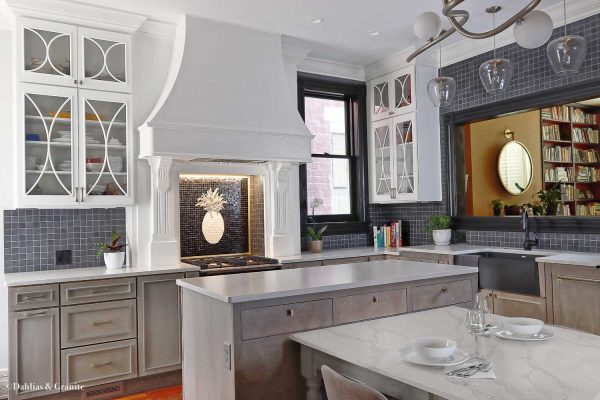
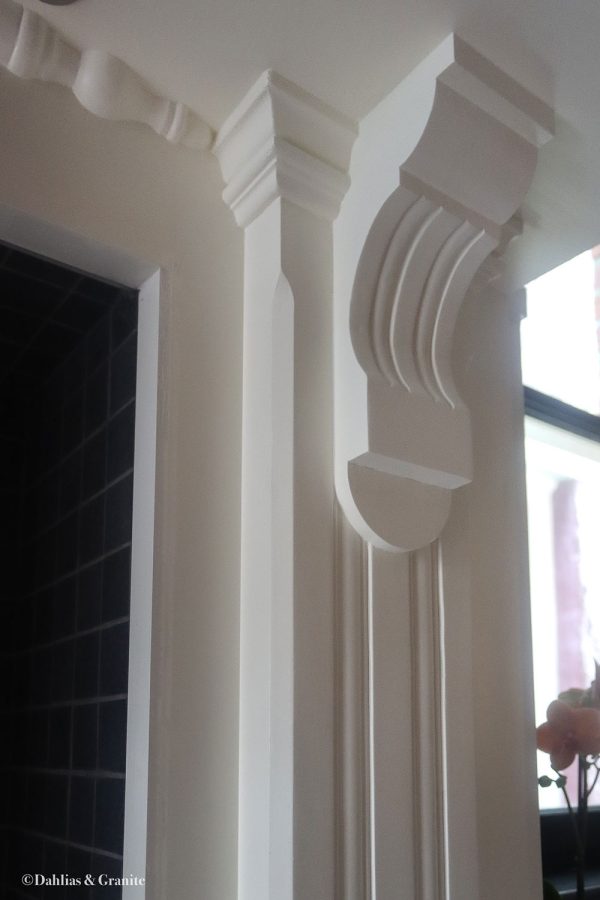
The heartwood pine floors run from this room through the rest of the home without interruption, refinished but not replaced, the same boards that have been there since 1889, and they’re what allows the kitchen to read as continuous with the rest of the home. The trim profiles match what’s in every other room. The corner blocks with their finials were fabricated to match the originals, and they do. The ceiling height is what it was when the house was built. The proportions are what the room had always had, before the 90s renovation divided it. What changed is everything inside that frame — and it changed in a way that the frame makes look inevitable.
That’s the goal of a Victorian kitchen renovation: not to create a kitchen that feels new, but one that feels as though it always belonged.
Designing the Range Wall in a Victorian Kitchen Renovation
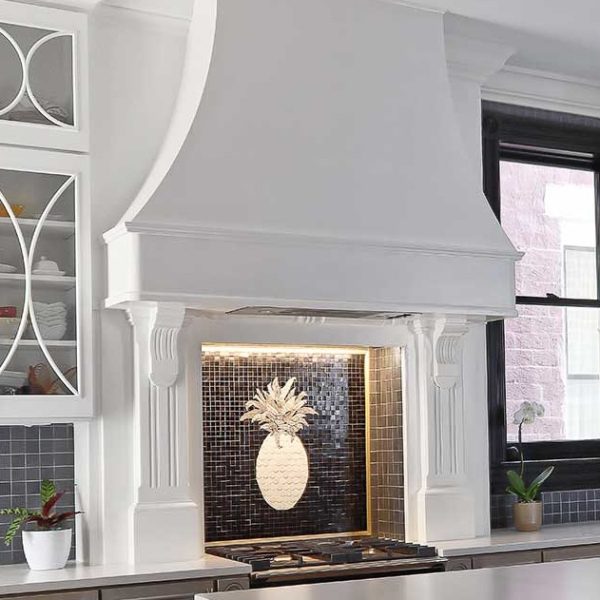
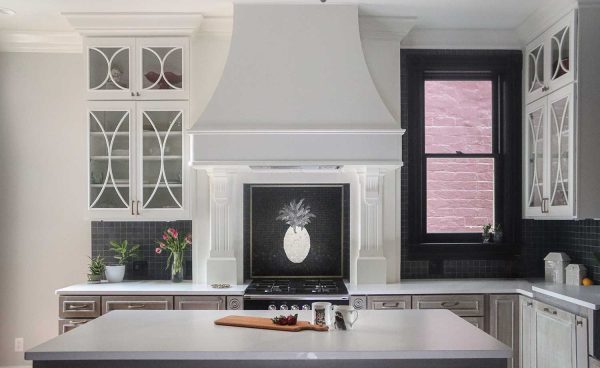
The original fireplace surround was deconstructed and its millwork used to build the range hood — painted white, running floor to ceiling, proportioned to the ceiling height of an 1889 Victorian rather than to the standard dimensions of a modern kitchen hood. The range sits in the exact spot where the firebox had been.
The dark tile behind it runs floor to ceiling, charcoal, and at its center sits a pineapple tile mosaic — the one detail in the room that doesn’t reference the house’s history. It references the client’s.
The chimney is capped; ventilation runs through the wall; the fireplace upstairs remained working throughout. Nothing was taken from the house. The kitchen just moved in.
The Cabinets
The cabinets are fully custom, stained in tones of grey that pick up the wallpaper in the staircase hallway — warm enough to read with the heartwood pine rather than against it, settled and considered, disappearing into the room rather than competing with it.
The upper cabinets are a mix of solid and glass doors with decorative muntins, the glass ones positioned where the client felt confident that organization would hold.
What It Feels Like to Be in It
The circulation moves in a circle. Two sinks anchor opposite sides of the room — the main sink on the south wall, centered perfectly on the passthrough, with the dishwasher, and a second small grey enamel bar sink on the north wall with a coffee bar — and the island sits at the center, which means you can move through the space without doubling back, without getting in anyone’s way, without the kitchen feeling like it has a wrong end.
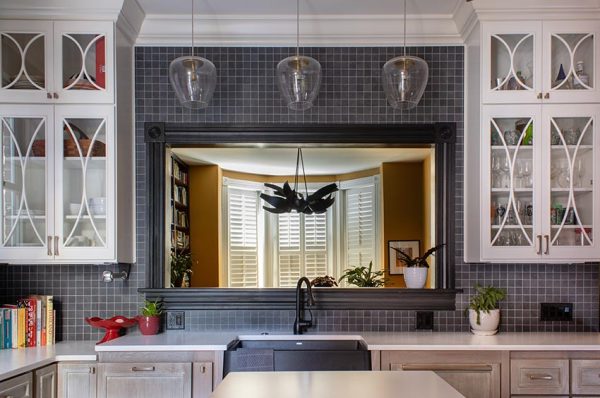
The south wall counter runs at 38 inches rather than the standard 36 — the client’s husband is 6’1″ and was dealing with back issues, and a counter at standard height meant leaning over the sink in a way that was adding up over time. Two inches makes a significant difference when you’re doing it every day.
The rest of the counters are standard height, all quartz, and the transition between the two is easy to read without being abrupt.
A freestanding table with a quartz top adjoins the east side of the island, running east to west while the island runs north to south. It’s not attached, and that’s the point — it can move, it can be pulled away, it can seat people when the kitchen is in entertaining mode.
It’s also a quiet nod to the Victorian kitchen worktable, the freestanding piece that sat at the center of every serious working kitchen before built-ins became the standard. It doesn’t announce itself as a historical reference. It just works the way those tables always worked.
Everyone has their own zone. The person baking and the person cooking can work at the same time, though they’ll need to coordinate on the oven — there’s one, and it’s a good one — and the drawer microwave lives where it doesn’t compete with anything.
A single glass-paned door on the north wall leads directly to the backyard — and from there to the trash and recycling area, which is the kind of practical connection that sounds minor until you’re carrying a bag of recycling outside in the rain.
The pet feeding station lives nearby: a raised bowl on a mat, chosen over a built-in for the same reason most practical decisions get made — it’s easier to clean.
To the west, the staircase hallway opens off the kitchen — wallpapered in a bird print, the same pattern as the front entryway but in a different colorway, which ties the two spaces together without repeating them exactly.
The electrical panel lives in that hallway, and it is completely invisible — covered in the same wallpaper, pattern-matched exactly across a removable cover with a lid that still opens fully. The paper wraps the edges of both the cover and the door, and the pattern lines up across all of it.
It took multiple steps, real patience, and two sets of hands — Steve, our specialist, and I worked it together, and it could not have been done alone. It’s one of those details that people stand in front of without quite understanding what they’re looking at, which is exactly the point.
When someone is entertaining and the kitchen is in use at the same time, the room handles it without effort. The passthrough keeps the living room close. The island gives people somewhere to land. The room is beautiful and peaceful. That’s exactly what a successful Victorian kitchen renovation should feel like.
The Finish Line
The room reads as though it has always been this way. Standing in the finished space, with the original floors underfoot and the original trim at the windows and the fireplace surround rebuilt as the range hood on the east wall, you cannot tell which parts are original and which parts are new.
In historic home renovation, that’s the only finish line that matters, and this kitchen crossed it.
FREQUENTLY ASKED QUESTIONS
How do you make a new kitchen feel like it belongs in a historic home?
Every decision has to be made in relation to what’s already there. Floors that match the originals. Trim profiles that match the originals, or are made to match them. Ceiling heights that are what they always were. Cabinets finished in a tone that works with the existing materials rather than asserts itself over them.
The goal is a room that reads as continuous with the rest of the house — not a renovation that announces itself as a renovation, but one that settles in and lets the house be what it always was.
Can you use a working Victorian fireplace as the location for a kitchen range?
With the right approach, yes.
In this home, the range went into the fireplace opening, the original surround was deconstructed and rebuilt as the range hood, the flue was capped, and ventilation was run through the wall. The fireplace upstairs remained working throughout the project.
The range wall reads as a natural continuation of the room’s architecture because the bones of that wall — the surround and the proportions — were already there.
Why are heartwood pine floors worth preserving in a historic renovation?
Because you cannot replace them with anything equivalent.
Heartwood pine from the late 1800s is old-growth wood — dense, tight-grained, and finished by 130 years of use into something no new material can replicate.
Refinishing original heartwood pine floors costs a fraction of replacing them, and what you get is infinitely more valuable than anything you could install new.
In a historic home renovation, the original floors stay whenever it is at all possible to keep them, because losing them is a loss the house never fully recovers from.
How do you design a kitchen that works for people of very different heights?
You design for the actual people using it rather than for a standard dimension.
In this kitchen, the south wall counter was raised to 38 inches to accommodate a 6’1″ homeowner with back issues, while the rest of the counters stayed at standard height. The difference is immediately functional and completely invisible to anyone who doesn’t know it’s there.
Custom design means designing for the people living in the home — not for the average.
Studio Olio specializes in historic home renovation in Denver and remotely. If you’re planning a kitchen renovation and want to understand what’s possible — let’s talk.
Project Journal
Every historic renovation has a story. The story of this Victorian kitchen renovation unfolds across three journal entries:
Why the Kitchen Moved
Understanding what wasn’t working and why the dining room became the new kitchen.
Relocating a Kitchen in a Historic Home
The structural, masonry, and millwork work required to make the move possible.
Victorian Kitchen Renovation: The Finished Space – (current article)
The completed kitchen and the details that make it feel as though it has always belonged.
→ View the 1889 Victorian Kitchen Project with the full scope, photos, and details.
The People Behind the Work
This project was completed with the help of Steve Drake, who brought the same precision to every job that he brought to everything else in his life — his tools were always where they should be, his vehicle was always clean, and the work he turned out reflected both.
On this project, Steve restored all of the original millwork rosettes and doors in the home and did most of the interior painting. Outside, he handled the digging, site work, drainage, and planting that made the yard what it became. He was my second set of hands when the wallpaper went up. His hands are in this project in more places than I can count. Working alongside him was one of the real privileges of this work. Steve passed away shortly after this project was complete. He is missed.
