
There is a particular quality of clarity that comes from a room stripped to its studs — not emptiness exactly, but honesty. You can see how the house was built and what decisions were made along the way, which ones were careful and which ones were expedient, which parts of the original structure are still sound and which have been quietly accumulating consequences. The dining room of this 1889 Church Hill Victorian had a few things to say. It was about to become the kitchen.
The client and our specialist did the demo themselves — which tells you something about the kind of homeowner she is. This wasn’t a passive renovation. She knows the house, she had already worked within Richmond’s historic district guidelines on previous projects, and she is not the kind of person who hands off the keys and waits for a phone call.
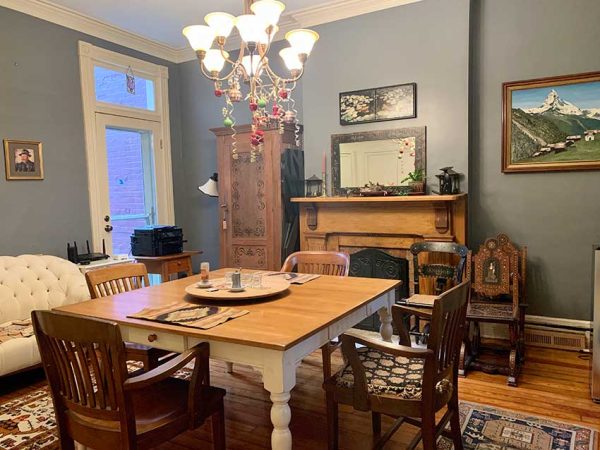
Before Demo Started
Before demo started, I had already brought in a structural engineer. The 1990s renovation that installed the decorative columns had done so without adding a beam, and the upper floor had been quietly sagging ever since. The report confirmed what the floor was telling us, and the beam went in during framing, after the masons had finished their work.
The east wall window was next. The original opening was still legible in the brickwork from outside — you could read it clearly if you knew what to look for. It had been bricked in and plastered over at some point, and the room had been operating without it ever since. When the plaster came off, the opening was exactly where we expected it to be. The morning light that had been missing from that wall for who knows how many decades came back.
Opening the Walls
The historic masons came in and did the work that had to happen before anything else could: they removed the lower portion of the brick firebox to make room for the range — installing a metal header to carry the weight of the upstairs fireplace on the same run — opened the bricked-in window on the east wall, re-bricked the original back door in what had been the kitchen, and opened the wall on the northwest side to take the new french doors, installing a header there as well.
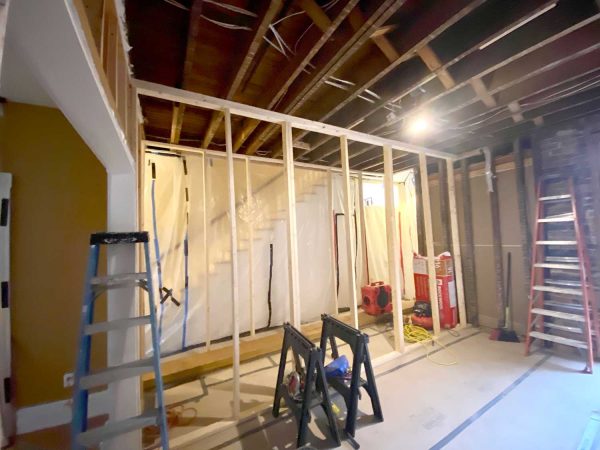
That back door had been the room’s connection to the yard when the house was built. Once the kitchen moved, it no longer made sense where it was.
The outdoor work had already been completed before the interior build began — a new patio, pergola, plantings, and shed — and the french door placement followed from that. Oriented to the finished yard rather than the original service entrance, the door went where we had designed the outside to be.
What Stays When You’re Relocating a Kitchen in a Historic Home
In a historic home renovation, the question of what stays is just as important as what comes out, and in this room the list was long.
The heartwood pine floors stayed — protected under rosin paper throughout demo and build, refinished when the work was done. The fireplace surround stayed, though not in its original form — more on that in a moment.
Throughout the entire home, our specialist stripped and refinished every original door, restored the hardware, and cleaned up the hinges — supplementing with reproduction hinges where the originals were beyond saving. Every original rosette was restored and reused. Where new millwork was needed — and in a room with new openings, there was plenty — it was made to match what was already there. If you didn’t know which pieces were new, you wouldn’t know. That’s the standard.
This approach aligns with the Secretary of the Interior’s Standards for Rehabilitation, which encourage repairing and preserving historic materials whenever possible rather than replacing them unnecessarily.
The Passthrough
The full-width double doorway between the new kitchen and the living room stayed, though we reduced the height of the opening. The lower portion became counter, sink, dishwasher, and storage — the door opening was exactly the right width for that run of cabinets. What remained above became a passthrough.
Victorian homes move light sequentially — room to room, front to back — and the openings between rooms are how that happens. Close that opening completely and the kitchen becomes its own separate world. Keep it, even at passthrough height, and the kitchen stays in conversation with the rest of the home.
Through the passthrough, the living room is always visible — warm gold walls, bookshelves, a round brass mirror — and the two rooms stay in the quiet conversation that a well-organized Victorian house is always having with itself.
What Came Back
The fireplace surround is the thing people ask about most when they see this kitchen, and the answer is that it never left — it just became something else.
The original Victorian surround was carefully deconstructed, and its millwork was used to build the range hood. The hood runs from the range to the ceiling, using the same profiles, the same proportions, and the same painted white finish that the surround had always had.
Behind the range, dark tile runs floor to ceiling — almost black — and at its center sits a pineapple tile mosaic, the one detail in the room that doesn’t reference the house’s history. It references the client’s.
The range sits in the exact spot where the firebox had been.
The Layout of a Historic Kitchen Relocation
The layout decisions in a historic kitchen relocation follow from what the room offers, not from an ideal plan imposed onto it. That’s particularly true when relocating a kitchen in a historic home, where original openings, windows, and architectural details often determine the layout more than modern convention does.
The room ran roughly 16 by 20 feet, with the range and restored east window on the east wall and the sink on the south wall.
The island sits at the center, where the room naturally places you when you walk in. The back of the island is built out with doors — outlets for charging, napkin storage, the things that accumulate in a kitchen and need somewhere to go that isn’t the counter.
A freestanding table adjoins the east side of the island, running east to west — not attached, able to move, able to seat people when the kitchen is in entertaining mode.
Custom stained cabinets run the perimeter, warm enough to read with the heartwood pine rather than against it. Upper cabinets have glass doors with decorative muntins. The heartwood pine floors run continuously from this room through the rest of the home, the way they always did.
Questions We Get Asked
How do you match new trim to original Victorian millwork?
You have a knife made from the existing profile. We pulled a piece of original trim, brought it to the millwork shop, and they ground a knife to match it exactly. Every new piece of casing and baseboard in the renovated areas was run from that knife.
It’s the only way to get it right — “close enough” is visible to anyone who knows what they’re looking at.
How do you relocate plumbing, gas, and electrical in a historic home?
Carefully, and with a plan for where the floors have to open.
We opened two sections of floor in areas that would be covered by cabinet runs — that’s where the plumbing connection to the rest of the home came up, along with the gas line extension and electrical. HVAC went to the toe kicks in several of the cabinets.
None of it is visible in the finished kitchen, but it required mapping the entire sequence before the first board came up.
Why relocate a kitchen instead of renovating it in place?
In this house, relocating the kitchen solved several problems at once. The former dining room offered better proportions, higher ceilings, and a stronger relationship to the yard once the new french doors were added.
Moving the kitchen also allowed the original kitchen space to become a flexible room with natural light and direct outdoor access. Sometimes the best solution isn’t improving an existing kitchen — it’s putting the kitchen where it always should have been.
What happens to the original kitchen space when the kitchen moves?
In this house it became Room 6 — a flexible space with good light, east-facing windows, and direct yard access. It holds plants, cats, and workout equipment.
Moving the kitchen didn’t leave a problem behind. It left a room that finally made sense.
Studio Olio specializes in historic home renovation in Denver and remotely. If you’re planning a kitchen renovation and want to understand what’s possible — let’s talk.
Project Journal
Every historic renovation has a story. The story of this Victorian kitchen renovation unfolds across three journal entries:
Why the Kitchen Moved
Understanding what wasn’t working and why the dining room became the new kitchen.
Relocating a Kitchen in a Historic Home – – (current article)
The structural, masonry, and millwork work required to make the move possible.
Victorian Kitchen Renovation: The Finished Space
The completed kitchen and the details that make it feel as though it has always belonged.
